
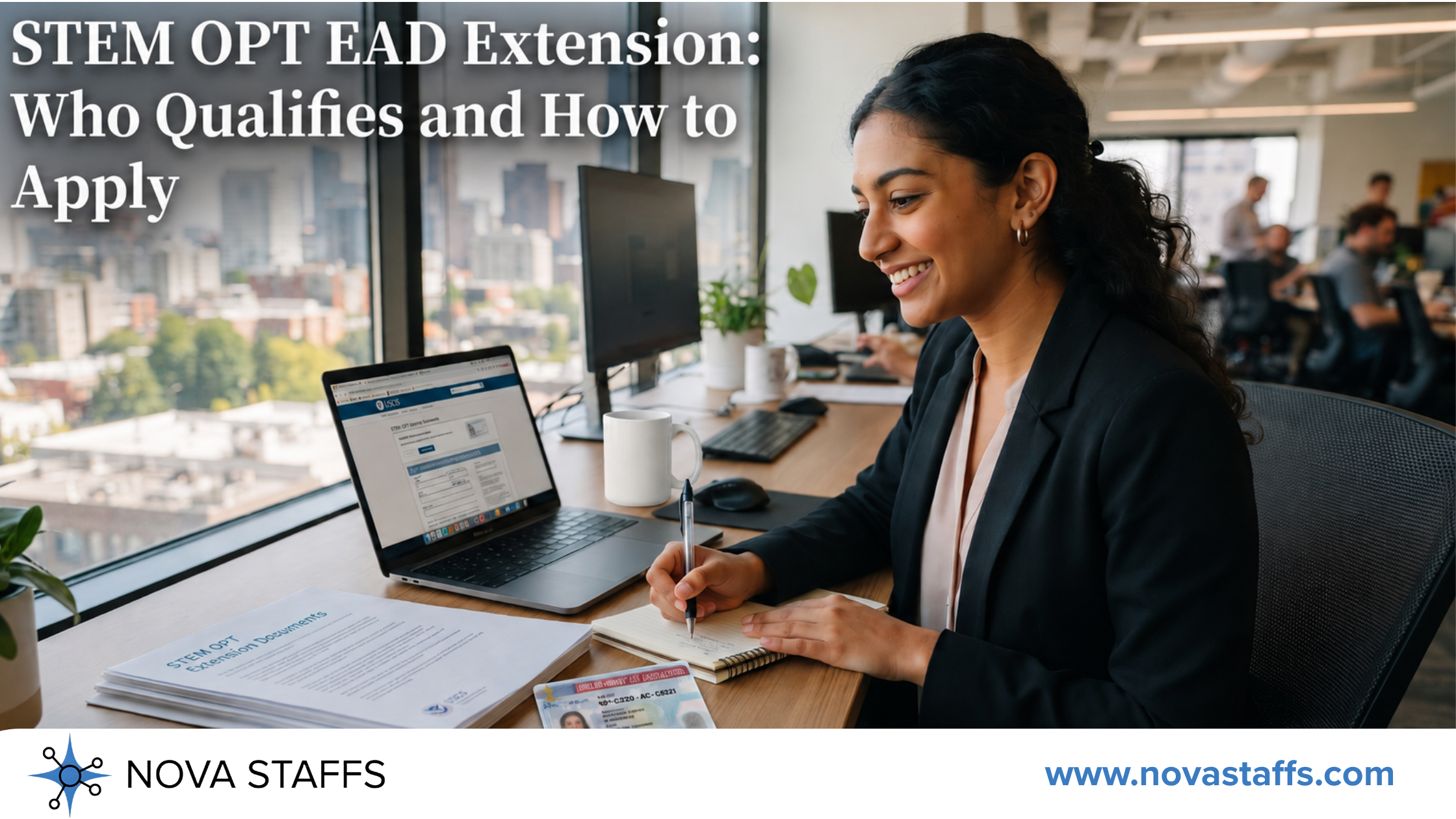
For international students studying in the United States, Optional Practical Training (OPT) can provide an important opportunity to gain professional experience related to their field of study. For eligible students with qualifying science, technology, engineering, and mathematics degrees, the STEM OPT extension can provide an additional 24 months of employment authorization after the initial 12-month post-completion OPT period.
However, obtaining a STEM OPT EAD extension is not simply a matter of submitting another employment authorization application. Students need to meet specific eligibility requirements, work with a qualifying employer, prepare a Form I-983 training plan, obtain a recommendation from their Designated School Official (DSO), and properly file Form I-765 with USCIS.
This guide from Nova Staffs explains the STEM OPT EAD extension process in simple terms, including who qualifies, what documents are generally required, how the application works, and common mistakes students should avoid.
An Employment Authorization Document, commonly called an EAD, is a document that demonstrates employment authorization in the United States for eligible individuals.
For F-1 international students, regular post-completion OPT can generally provide up to 12 months of practical training related to their major. Students who qualify for the STEM OPT program may be eligible for an additional 24 months of STEM OPT, creating up to 36 months of practical training when the initial OPT period and STEM extension are combined.
The STEM OPT extension is designed for eligible F-1 students who have earned qualifying STEM degrees and are participating in practical training with an eligible employer.
USCIS identifies the STEM OPT extension under the Form I-765 eligibility category (c)(3)(C). USCIS instructions state that eligible applicants may file Form I-765 up to 90 days before the expiration of their current post-completion OPT and must include an appropriately endorsed Form I-20.
Understanding eligibility is one of the most important parts of the STEM OPT process. Not every F-1 student on OPT automatically qualifies.
Generally, a student must satisfy several requirements.
The STEM OPT program is intended for qualifying F-1 students. You must maintain the required F-1 status and comply with the applicable rules governing your OPT participation.
Your DSO plays an important role in confirming your eligibility and updating your SEVIS record before you submit the STEM OPT EAD application.
Your degree must appear on the current STEM Designated Degree Program List.
Qualifying fields may include areas such as computer science, information technology, engineering, mathematics, data science, and other approved STEM disciplines. The exact eligibility depends on the degree program and its classification, so students should confirm their specific program with their school.
A STEM-related job title by itself does not make someone eligible. The degree supporting the STEM OPT extension must meet the applicable requirements.
The STEM OPT extension is an extension of eligible post-completion OPT. Students generally need to be in their initial 12-month post-completion OPT period when applying.
The STEM extension does not replace the initial OPT period. Instead, it adds an additional 24 months when the student and employment meet the requirements.
The employer is an important part of the STEM OPT process.
For STEM OPT employment, the employer generally needs to participate in E-Verify and meet the program's requirements. USCIS specifically requires applicants to provide the employer's name as listed in E-Verify and the appropriate E-Verify identification information on Form I-765.
The position must also provide legitimate practical training related to the student's qualifying STEM degree.
STEM OPT is intended to provide structured practical training connected to the student's qualifying STEM field.
For example, a student with a qualifying computer science degree may work in an appropriate software development, data engineering, systems, or related technical role if the position meets the applicable STEM OPT requirements.
The relationship between the degree, job responsibilities, and training objectives should be clearly explained in the required training plan.
The Form I-983, Training Plan for STEM OPT Students, is a central part of the STEM OPT process.
The student and employer work together to complete the training plan. It describes the student's role, learning objectives, supervision, compensation, and other information about the practical training opportunity.
The employer must certify that the training opportunity satisfies applicable requirements. The training should provide structured and guided learning related to the student's STEM field.
The student should carefully review every section of the I-983 before submitting it to the DSO.
Once you determine that you may qualify, the next step is to follow the application process carefully.
Start by confirming:
If you are unsure about any requirement, speak with your DSO before preparing your application.
Your employer should meet the program requirements, including the applicable E-Verify requirement.
Students should not wait until the last moment to find a qualifying employer. Before accepting an opportunity, ask the employer whether it can support the STEM OPT process and complete the employer portions of Form I-983.
This is especially important for international students searching for technology positions because not every company or position will meet STEM OPT requirements.
Work with your employer to complete Form I-983.
The form establishes the practical training plan and explains how the employment will help you develop knowledge and skills connected to your STEM degree.
The employer also has responsibilities under the training plan. For example, the official I-983 materials state that the employer must report certain changes and termination or departure information to the DSO.
Provide the required information and completed training plan to your school's DSO.
The DSO reviews the information and, if you qualify, makes the STEM OPT recommendation in SEVIS and issues an updated Form I-20.
Do not skip this step. Your DSO's recommendation is an important part of the STEM OPT EAD application process.
The next major step is filing Form I-765, Application for Employment Authorization, with USCIS.
For STEM OPT, the relevant eligibility category is generally (c)(3)(C).
USCIS instructions indicate that a STEM OPT applicant may file Form I-765 up to 90 days before the expiration of the current post-completion OPT authorization. The applicant must also submit the Form I-20 endorsed by the DSO within the required period before filing.
Carefully review your personal information, school information, employment information, eligibility category, and supporting documents before submitting the application.
Your STEM OPT EAD application should include the documentation required by the current USCIS instructions.
Depending on your circumstances, documentation may include:
USCIS specifically notes that applicants based on a previously earned STEM degree may need to provide evidence of the prior STEM degree and accreditation information under the applicable circumstances.
Always use the current USCIS filing instructions because document requirements and filing procedures can change.
Timing is extremely important.
USCIS instructions state that Form I-765 for the 24-month STEM OPT extension can be filed up to 90 days before the expiration of the student's current post-completion OPT.
Because preparing the I-983, coordinating with the employer, obtaining the DSO recommendation, receiving the updated I-20, and preparing Form I-765 can take time, students should begin preparing well before their OPT expiration date.
Waiting until the final days can create unnecessary stress and increase the possibility of mistakes.
After submitting Form I-765, USCIS processes the application and may issue a receipt notice.
Students should monitor their USCIS case and keep copies of all submitted documents.
A USCIS online account can also be used to access information about immigration applications and case updates.
If USCIS requests additional evidence, the student should carefully review the request and respond within the specified deadline.
Because processing times can change, students should avoid relying on unofficial timelines when making employment or immigration decisions.
Getting the STEM OPT EAD is not the end of the process.
Students have continuing responsibilities throughout the STEM OPT period.
Students generally need to keep their school informed about required changes involving employment, address, and other information covered by STEM OPT reporting rules.
The STEM OPT program includes self-evaluation requirements connected with Form I-983.
DHS guidance explains that students are required to complete an initial evaluation at the appropriate 12-month point and a concluding evaluation at the end of the practical training opportunity. The evaluation must be submitted to the DSO within the applicable timeframe.
Your employment should continue to satisfy the STEM OPT training requirements. The work should remain connected to your qualifying STEM degree and the objectives described in the training plan.
STEM OPT employment has specific requirements concerning practical training hours. DHS materials identify a minimum of 20 hours per week for the qualifying practical training opportunity.
Students should always verify their individual situation and current requirements with their DSO.
A small mistake can create significant problems during an employment authorization process. Some common issues include:
Do not wait until the final days of your initial OPT period. Start the process early enough to coordinate with your employer and DSO.
Not every employer qualifies for STEM OPT. Confirm the employer's eligibility before relying on a job offer for your extension.
The I-983 should accurately describe your employment, supervision, compensation, training objectives, and other required information.
For the STEM OPT extension, applicants generally use the applicable STEM OPT eligibility category on Form I-765. Review the current USCIS instructions carefully.
STEM OPT students have continuing reporting and evaluation responsibilities. Keeping your DSO informed is essential.
Having a STEM degree does not automatically mean every job qualifies for STEM OPT. The employment must satisfy the applicable requirements and have a proper relationship to the qualifying STEM degree.
Finding a qualifying opportunity can be one of the biggest challenges for international students approaching the STEM OPT extension.
NovaStaffs helps job seekers explore career opportunities in the U.S. IT and technology market. For students and professionals looking for roles during their OPT or STEM OPT period, understanding employer requirements, job responsibilities, technical skills, and career alignment can make the job search more focused.
Nova Staffs can help candidates explore relevant IT opportunities and better understand what employers typically look for when hiring technology professionals.
However, employment placement support is different from immigration or legal advice. Candidates should work with their DSO and, when necessary, a qualified immigration attorney for questions about individual immigration eligibility or legal status.
The OPT EAD and STEM OPT extension can provide valuable opportunities for eligible F-1 international students to gain professional experience in the United States. The additional 24 months of STEM OPT can give qualifying graduates more time to develop technical skills, build professional experience, and pursue long-term career opportunities.
The process requires careful planning. Students need a qualifying STEM degree, eligible employment, an appropriate employer, Form I-983, DSO recommendation, Form I-765, and the required supporting documentation.
The most important step is to start early. Confirm your eligibility, communicate with your DSO, coordinate with your employer, prepare your documents carefully, and always check the latest USCIS and DHS guidance before filing.
For international students searching for technology opportunities during OPT or STEM OPT, NovaStaffs can be a useful resource for exploring relevant IT career opportunities in the U.S.
An OPT EAD is an Employment Authorization Document issued to eligible students who are authorized for employment through Optional Practical Training. It serves as evidence of employment authorization during the applicable OPT period.
The STEM OPT program can provide an additional 24 months of employment authorization for eligible F-1 students, subject to applicable requirements.
Generally, qualifying F-1 students with an eligible STEM degree who meet STEM OPT requirements and have qualifying employment with an eligible employer may apply. Eligibility depends on the student's specific circumstances and current regulations.
Generally, students need qualifying STEM OPT employment and an eligible employer to obtain the required STEM OPT recommendation and complete the training plan.
Form I-983 is the Training Plan for STEM OPT Students. It describes the training opportunity, learning objectives, supervision, compensation, and other required details about the STEM OPT employment.
USCIS instructions state that eligible students may file Form I-765 for the STEM OPT extension up to 90 days before their current post-completion OPT expires.
Yes. STEM OPT employment generally requires an eligible employer participating in E-Verify, and USCIS requires relevant E-Verify employer information in the STEM OPT Form I-765 filing.
No. The position must satisfy applicable STEM OPT requirements and be directly related to the qualifying STEM degree. A STEM degree or technical job title alone does not automatically establish eligibility.
Changing employers during STEM OPT involves specific requirements, including updating the required training plan and reporting information through your DSO. Students should coordinate with their DSO before making a change.
Nova Staffs can support job seekers in exploring relevant employment opportunities, but immigration eligibility and legal advice should come from your DSO or a qualified immigration attorney.
Join thousands of successful professionals who found their dream
jobs with Nova Staffs.